
Home / Our drinks / Guinness
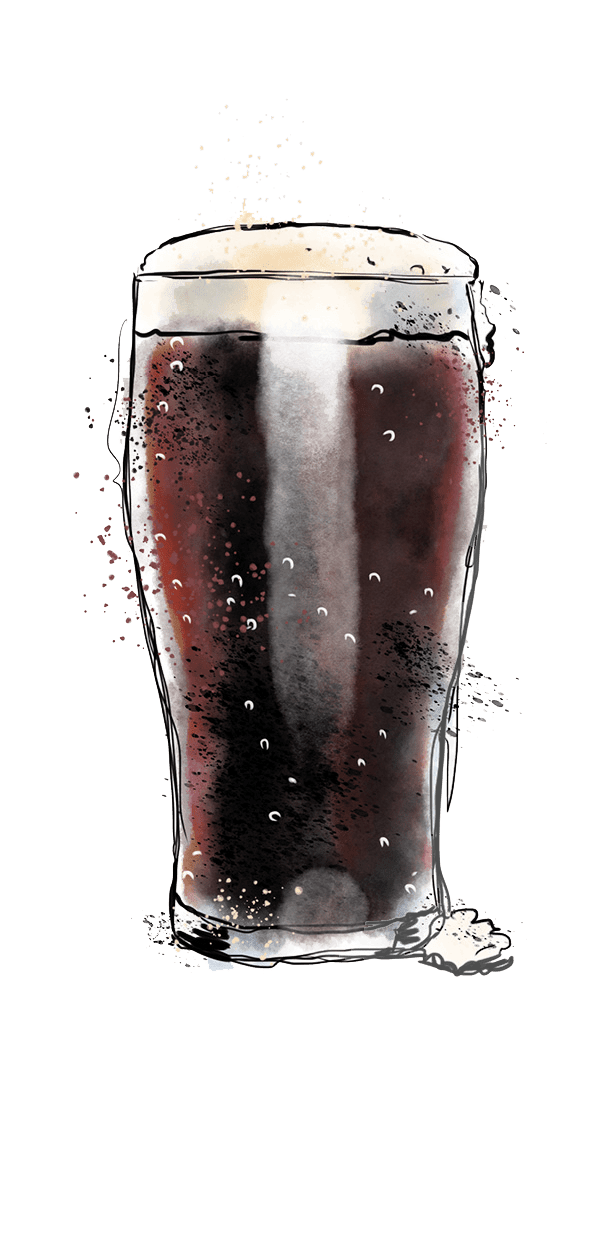
Guinness
Guinness is an Irish dry stout that originated in the brewery of Arthur Guinness (1725–1803) at St. James’s Gate brewery in Dublin, Ireland.
Guinness is made from water, barley, roast malt extract, hops, and brewer’s yeast. A portion of the barley is roasted to give Guinness its dark colour and characteristic taste. It is pasteurised and filtered.
History
Arthur Guinness started brewing ales in 1759 at the St. James’s Gate Brewery, Dublin. On 31 December 1759, he signed a 9,000 year lease at £45 per annum for the unused brewery. Ten years later, on 19 May 1769, Guinness first exported his ale: he shipped six-and-a-half barrels to Great Britain.
There have been claims that Arthur Price, a Welshman, took the original recipe with him to Ireland where he hired a servant, Richard Guinness, whose son later opened the brewery.
“Stout” originally referred to a beer’s strength, but eventually shifted meaning toward body and colour.
Arthur Guinness started selling the dark beer porter in 1778.The first Guinness beers to use the term were Single Stout and Double Stout in the 1840s. Throughout the bulk of its history, Guinness produced ‘only three variations of a single beer type: porter or single stout, double or extra and foreign stout for export’. Porter was also referred to as “plain”, as mentioned in the famous refrain of Flann O’Brien’s poem “The Workman’s Friend”: “A pint of plain is your only man.”
Arguably its biggest change to date, in 1959 Guinness changed its whole composition by introducing nitrogen. The introduction of nitrogen changed the fundamental texture and flavour of Guinness of the past as nitrogen bubbles are much smaller than CO2, giving a “creamier” and “smoother” consistency over a sharper and traditional CO2 taste. This fundemental - and arguably pivotal moment in Guinness’ 258 year history - started in 1959 when Michael Ash - a mathematician turned brewer - after an extensive four year journey of experimentation, discovered the mechanism to make this possible. As a result of this, when a pint of Guinness is poured today, you now see the classic “serge and settle” effect (nitrogen bubbles cascading down the side of the pint glass) which is ultimately the extensive work and genius of Michael Ash.
Nitrogen is less soluble than carbon dioxide, which allows the beer to be put under high pressure without making it fizzy. High pressure of the dissolved gas is required to enable very small bubbles to be formed by forcing the draught beer through fine holes in a plate in the tap, which causes the characteristic “surge” (the widget in cans and bottles achieves the same effect). This “widget” is a small plastic ball containing the nitrogen with also just a little beer itself. The perceived smoothness of draught Guinness is due to its low level of carbon dioxide and the creaminess of the head caused by the very fine bubbles that arise from the use of nitrogen and the dispensing method described above. “Foreign Extra Stout” contains more carbon dioxide, causing a more acidic taste.
Although Guinness may appear to be black, it is officially a very dark shade of ruby.
Guinness has a significant share of the African beer market, where it has been sold since 1827. About 40 percent of worldwide total Guinness volume is brewed and sold in Africa, with Foreign Extra Stout the most popular variant. Three of the five Guinness-owned breweries worldwide are located in Africa.
The beer is brewed under licence internationally in several countries, including Nigeria, the Bahamas, Canada, Cameroon, Kenya, Uganda, South Korea, Namibia, and Indonesia.The unfermented but hopped Guinness wort extract is shipped from Dublin and blended with beer brewed locally.
The UK is the only country to consume more Guinness than Ireland. The third-largest Guinness drinking nation is Nigeria, followed by the USA.
Make sure you order this drink first when you’re dong a round at the bar. You’ll be waiting a while but that’s all part of its charm. Enjoy!